The Ninth Appointment: A Murder of Time
Time marches, circles, swirls and sometimes stops…
Snow fell again that week, light as dust, coating the gargoyles along Fifth Avenue. In Geier’s office, the radiator groaned and hissed, matching the rhythm of his pulse. He hated February. It always smelled of rust and regret.
Across from him, Lark was typing rapidly, her tablet screen reflecting in her glasses. She looked entirely absorbed, half in the present, half in whatever dimension her mind was building.
Geier and Lark didn’t seem to notice him. No knock on the door. No footsteps. As if out of thin air , Detective Vasquez appeared brushing snow from his trench coat.
Geier looked up and grinned. “You look like the New York, winter version of Columbo.”
“Three murders,” Vasquez said, stamping slush from his boots. “No connection. No motive. But there’s something wrong with the time.”
Lark shook off her reverie. “Detective Vasquez, how nice to see you. No small talk. Breathe. Have a cup of coffee. I just made a fresh pot. Lark closed her eyes and took a deep breath. “Organic from Kenya. Can you smell it?”
“Sorry, no time to waste. I’ll breathe later,” Vasquez said.
Geier arched an eyebrow. “Time?”
“All three watches on the victims were stopped,” Vasquez said, tossing photos onto Geier’s desk. “Different times, same minute marks: 3:33, 7:07, 11:11. Coroner says each of their bodies was dead for an hour when we found them, but rigor set in differently for each. It’s like the watches don’t agree with the corpses.”
Lark leaned over the photos, tracing the frozen watch faces with a gloved fingertip. “Maybe they don’t.”
The First Scene
The first crime scene was a studio apartment above a laundromat on 10th Street. A lingering detergent smell mingled with coppery blood.
The victim, an artist named Mara Kane, had been found slumped in a chair, a paintbrush still between her fingers. Her watch and the clock on the wall read 3:33.
Lark crouched beside the chair. The paint on the canvas shimmered faintly, wet even after hours. “She was painting when she died,” she said. “But look—no brushstrokes overlap. She didn’t finish.”
Geier ran a hand over the back of his neck. “She stopped mid-movement.” He noticed something subtle, a faint warmth still emanating from the clock’s brass rim, as if it had recently absorbed sunlight.
Outside, sirens wailed through the sleet.
“She painted Time,” Lark murmured. The half-finished canvas showed a swirl of gold and black, an hourglass shape stretched and distorted. “She was working on a commission for someone, something about perception and memory.”
“Perception I understand,” Geier muttered. “Memory’s just another lie the brain tells itself.”
Lark smiled faintly. “Or the only truth we get to keep.”
Vasquez raced them uptown in his
The Second Scene
standard-issue, black Dodge Charger. Another body—this one in a subway service corridor near Columbus Circle. The air was thick with machine grease and the smell of wet concrete. A maintenance light flickered overhead, its pulse irregular as a failing heartbeat.
The victim, a software engineer named Leo Santoro, lay on his side. His smartwatch glowed dimly… 7:07 a.m. Its battery almost drained.
“Different world down here,” Vasquez muttered.
“Different time,” Lark corrected. She was staring at the graffiti along the tiled wall: concentric circles spiraling inward, each one labeled with a year: 1990, 2000, 2010, 2030. In the center, the word NOW scrawled in red.
Geier knelt, pressing two fingers to the man’s wrist. Cold, rigid, but there was a faint static under his touch—a prickling energy, like touching a TV screen after it’s shut off. His nostrils filled with the scent of ozone, sharp and metallic, stinging his eyes.
“Electric residue,” Vasquez offered.
“Or memory burn,” Lark said.
They exchanged a look.
The Third Scene
The third body turned up in the lobby of a defunct clock factory on the East River. Shards of glass littered the marble floor, catching the moonlight like frozen rain. The old factory smelled of oil, brass, and dust… time’s own perfume.
The victim was an elderly physicist, Dr. Henry Rao, once famous for his work on temporal perception. He sat upright against a wall of broken clocks, his hands folded neatly in his lap. Every clock read 11:11.
Geier lit his pipe, a reflex Vasquez had long given up scolding him for. “All the same time. Coincidence?”
Vasquez snapped on a glove and inspected the victim’s head and neck. “No apparent cause of death for any of these victims.”
“Pattern,” Lark said. “Repetition. Maybe he wanted to leave a message.”
She bent to examine his pocket watch, noticing a hairline crack across the glass. The crack glowed faintly blue.
When she held it closer, the air trembled, just enough for the snow outside to seem suspended. Then the smell hit her: not dust or oil, but petrichor, fresh and impossible inside this dead building.
“Something happened here,” she whispered.
Geier’s voice was soft. “Something’s still happening.”
Threads
Back at the office, Lark pinned photos of the victims across her tablet’s digital board—faces, times, and locations forming a triangulated map. “All three were part of a cognitive-temporal study run out of Columbia ten years ago,” she said.
“Testing human perception of time under extreme stress,” Geier recalled. “I reviewed their paper once. Nonsense, mostly.”
“Nonsense that killed three people,” Vasquez said.
Lark zoomed in on the map. “The study’s head researcher, Dr. Nathan Choudhary, disappeared in 2015. He claimed he’d found a way to make people see forward. He called it ‘temporal echo recall.’ ”
Geier grunted. “More word salad.”
“No,” Lark said softly. “It’s what I do sometimes.”
He looked at her, really looked. “What you do?”
She hesitated. “When I dream of the victims. The details I shouldn’t know… it’s not guessing. It’s remembering forward.”
The words hung in the air like frost.
The Clinic
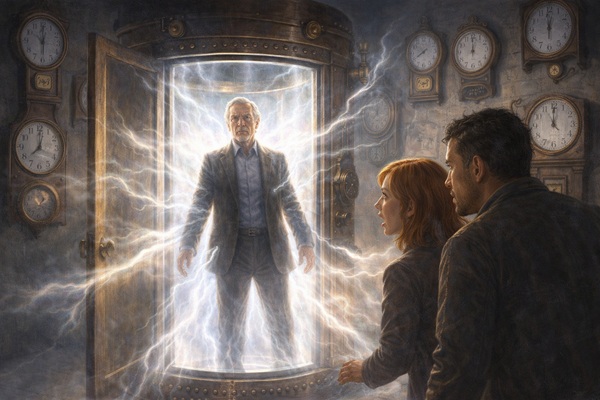
They traced Choudhary’s old clinic to a shuttered brownstone near Morningside Heights. Inside, the electricity was alive, together with a faint hum beneath the silence. The walls were lined with antique clocks, hundreds of them, all stopped.
Lark’s flashlight beam caught a whiteboard scrawled with equations, arrows, and phrases: Subjective Lag = Conscious Delay, Memory Forward = Time Folded.
“Psychobabble,” Geier muttered, but his hand trembled slightly as he adjusted his pipe.
Lark brushed dust from a glass tank the size of a phone booth. Inside, a reclining chair faced a mirror. “This is it,” she said. “The echo chamber. He tested visual recall while manipulating pulse frequency. It tricks the brain into experiencing moments before they occur.”
“Or makes them hallucinate,” Geier said.
Vasquez tapped a stack of files on a desk. “Look. Three test subjects—Kane, Santoro, Rao. Our victims.”
Lark’s pulse quickened. “They weren’t just test subjects. They were still participating. Look at the timestamps, weekly sessions even after the study closed.”
She turned to Geier. “What if Choudhary wasn’t gone? What if he was stuck between?”
The Revelation
Without hesitating, Geier pulled down on the red lever thrat protruded from the left side of the chamber. The chamber came to life with a low whine. The air shimmered like heat above asphalt.
“Dr. Geier, maybe you shouldn’t—” Lark began, but he was already stepping inside.
The world slowed. The hum deepened until it was nearly a vibration in his bones. The room dimmed, the clocks began to tick… backward.
He saw flashes: the painter freezing mid-stroke; the engineer reaching for a wall that wasn’t there; the physicist smiling at something behind him. Then a face: Choudhary, eyes wide with terror. “I opened it too far,” he gasped. “Time remembers everything. Sometimes, it remembers us.”
Geier’s chest constricted. He reached toward the image, but his hand passed through mist. The scene fractured, like glass hit by a hammer, and he was back in the chair.
Lark’s face hovered above him. “Saul! Are you all right?”
He blinked. “I saw it. He tried to fold time into itself. It collapsed, dragging them through the echoes. They died in their own future memories.”
Lark shivered. “Then we can stop it.”
“How?” Vasquez asked.
“By closing the loop,” she said. “Choudhary’s still in there—his perception anchored to now. If we can sync the clocks to one fixed moment, we can end the drift.”
Lark understood the cost before she spoke it aloud. To stop the drift meant anchoring every lost victim in one perfect instant, restoring the dead to their rightful moments. Not resurrecting them but providing peace and closure.
While restoring time’s flow would help those three lost souls, it would trap Choudhary in the fold he had created, a kind of purgatory from which he would never emerge. His consciousness would become the hinge, the second that never ended. It was mercy and punishment balanced on the same tick of a clock.
They adjusted the wall of stopped clocks to 7:07, the median time between all three deaths.
The chamber lights flared. For a heartbeat, all sound vanished. Then the clocks began ticking in unison.
Aftermath
The police later found no body, no sign of Choudhary, only faint scorch marks where the tank had stood. The air smelled of rain, though the sky outside was clearing now.
Back in the office, Geier watched the hands of his pocket watch move again, steady and deliberate.
“Looks like we restored order,” Vasquez said.
“Maybe,” Geier said. “Or maybe time just decided to let us catch up.”
Lark smiled faintly, sipping her tea. “You believe now that it’s not real?”
“Oh, it’s real,” he said. “Just not polite.”
She studied him for a long moment. “What did you see in there?”
He didn’t answer. In truth, he’d seen a hospital room bathed in late-afternoon light, his wife turning her head toward him, muttering something he couldn’t quite hear. He leaned forward and in the faintest whisper he had heard her say, “I’m s-o-r-r-y.”
A moment past, or that hadn’t yet happened, or perhaps one he had been remembering forward.
Final Beat
That night, as the snow resumed its silent fall, Lark sat at her desk writing notes. A subtle breeze stirred the edges of her pages. She glanced at the clock—11:11—and smiled.
Across the city, Geier’s watch ticked once, stopped, then started again.
Time, it seemed, was giving them one more chance to stay in step.
Somewhere in the city, unseen and uncounted, a single clock might still stand still, its hands forever circling the moment when one man tried to master time and became part of it instead.
Geier exhaled, making a sound soft as a sigh. “He wanted eternity,” he murmured, “and he got it.”
~END~
We’d love to know if you are enjoying the mystery stories of Dr. Geier and Dr. Lark. If so, please leave a comment below.
For more stories like this, check out: The Last Appointment: 30 Collected Short Stories
Catch up on my original fast-paced thriller NOT SO DEAD and the Sam Sunborn Series
They are available on Amazon and BarnesandNoble.com
Or my children’s adventure book: Nougo and His Basketball.
And read for FREE some of Charles Levin’s short stories:
The First Appointment
The Last Candy Store in East Apple
I’m Processing
Books Unread
Nora Delivers the Package
The Permission Slip
10 Life Lessons I Learned from Playing Poker
Missing the Ghost in the Palace Theater
Moon Landing Memories
Word Drunk
Oh, and please do join the Mailing List for future stories and posts
